

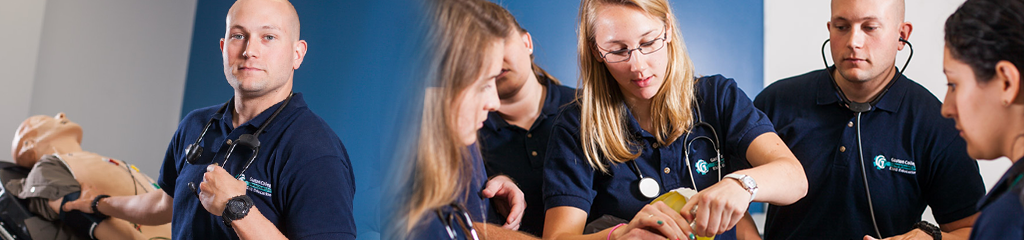
Emergency Medical Technician Certificate

The links below will provide additional information on these programs.
Program Outcomes
For students entering the field of Emergency Medical Services (EMS), successful completion of this program is required to obtain State and National Registry certification as an EMT. This program also serves as the foundation of training for individuals seeking to advance to the level of Paramedic. After successful completion, EMT candidates will:
- Examine and analyze the nature and seriousness of the patient’s condition or extent of injuries to assess the need for emergency medical care, perform appropriate medical care based on assessment findings of the patient’s condition, lift, move, position and otherwise handle the patient to minimize discomfort and prevent further injury.
- Demonstrate the roles and responsibilities of an EMT within an EMS system, perform the basic concepts of development, pathophysiology and pharmacology to assessment and management of emergency patients, be able to properly administer medications, and apply effective communication with patients, peers, and healthcare professionals.
3, Perform airway management including oxygenation and ventilation of a patient.
- Demonstrate a proper history and perform a comprehensive physical examination on any patient and communicate findings to others.
- Demonstrate integration of pathophysiological principles and analyze assessment findings to formulate a field impression and implement the treatment plan for the medical patient.
- Demonstrate integration of pathophysiological principles and analyze assessment findings to formulate a field impression and implement the treatment plan for the trauma patient.
- Demonstrate integration of pathophysiological principles and analyze assessment findings to formulate a field impression and implement the treatment plan for neonatal, pediatric, and geriatric patients, diverse patients, and chronically ill patients.
- Demonstrate integration of pathophysiological principles and analyze assessment findings to formulate a field impression and implement the treatment plan for patients with common complaints.
- Perform safety management principles at the scene of an emergency.
- Apply general knowledge and understanding of managing an emergency medical services system.
1 1. Operate/drive emergency vehicle
Credits, Hours, and Prerequisites
Number Contact Hours: 248
Number Class (Lecture) Hours Per Week: 4-6
Number Laboratory Hours Per Week: 4-6
Number Clinical/Work Experience Hours: 48
Prerequisite(s): High School diploma, GED, advanced degree or successful reading placement test score
Corequisite(s): *Valid driver’s licenses
*Without valid driver license students will not be able to participate in driving portion of class.
For additional information or upcoming class dates, contact Dawn Boone at 704-922-6241 or questions to Kimberly Parsley