
News

Show Mobile Menu

Avalo Cotton unveils project from genetically diverse cotton harvest

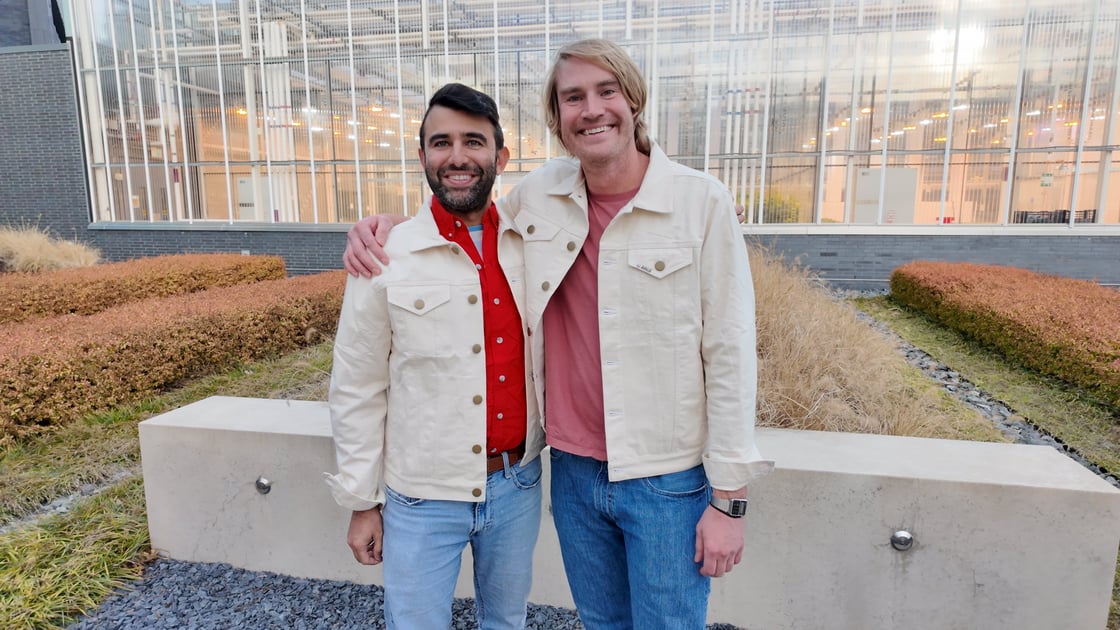
Two males smiling and wearing the Avalo Genesis Jackets that were created through a partnership with Gaston's Textile Technology Center.Durham-based Avalo Cotton and Gaston College’s Textile Technology Center recently unveiled what had been nearly two years in the making.
The result of their efforts is the “Genesis Jacket,” which began its journey in 2024 when Avalo saved cotton harvested from its inaugural diversity trial.

Avalo’s first harvest yielded a handful of bins of fiber, filled with the most genetically complex cotton harvests to date.  

“In a field in North Texas, we grew 449 individual cotton varieties from across the world, and across time,” Avalo Cotton’s recent January newsletter said. “Some are more modern types cultivated during the era of agricultural industrialization, others predate the United States’ expansion west of the Mississippi River, and some even predate Columbus’s arrival on Hispaniola.

“Together, these individuals’ genetics serve as the foundation of the Avalo cotton program. Their unprecedented diversity offers the keys to natural fiber that is more resilient, sustainable and vibrant than ever before.  

According to the newsletter, Avalo Cotton produced just 17 undyed, embroidered jackets, each created in partnership with Gaston College and NYC Factory.

Avalo is a leader in mapping GxE (gene by environment) interactions. The company’s patented approach matches genetics to climate conditions, forming the foundation of its regional adaptation strategy for cotton.

Jasmine Cox-Wade, Executive Director of Textile Technology at Gaston College’s Kimbrell Campus in Belmont, was thrilled with the program’s success.

“Participating in the development and testing of the yarn used in the Genesis Jacket reflects exactly what the Textile Technology Center strives to do,” Cox-Wade said. “We bridge scientific innovation with real-world textile applications. Our team is proud to support projects that push the boundaries of what natural fibers can become.

“The hard work of our staff brings decades of combined experience in spinning, fiber testing, and textile manufacturing. A project like the Genesis Jacket gives our team an opportunity to apply that expertise in a hands-on way, helping transform a historically significant cotton harvest into a functional, beautifully crafted product.”

Gaston College Textile Technology students participate in project on sustainable textiles

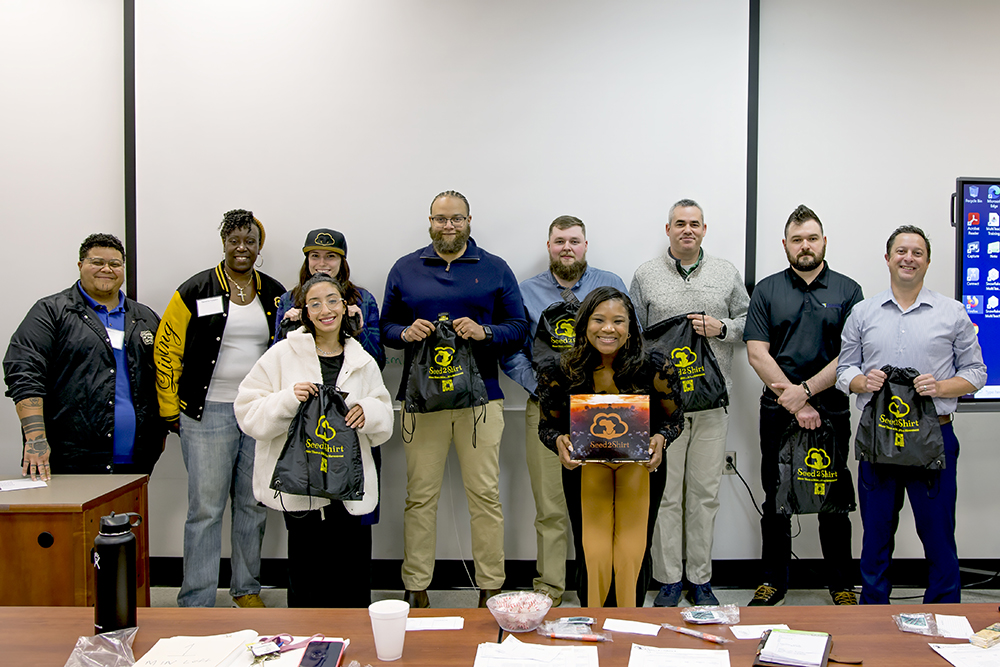
Gaston Textile students participated in Seed2Shirt project.Students in the Gaston College Textile Technology program recently participated in a semester-long project aligned with the principles of fiber, textile technology processes and sustainability taught in the program’s Fundamentals of Textiles course. This project, the Seed2Shirt Textile Design Challenge, was sponsored by Seed2Shirt, a company that is a client of the Gaston College Textile Technology Center.

Seed2Shirt, based in Lompoc, California, with offices in Greensboro, N.C., is one of the first black woman-owned vertically integrated ethical T-shirt manufacturing and boutique cotton merchant companies in the U.S. Its products are ethically and sustainably manufactured from cotton material from African and African American cotton farmers. With a business-for-good model, a percentage of every sale goes to their Farmer Enrichment Program which supports the very farmers they source from.

The Textile Technology Associate in Applied Science degree program prepares students for work as Textile Technicians and as Textile Designers. Nine students participated in the project, which provided opportunities to become familiar with the sponsoring organization through co-sponsored course assignments, special laboratory activities, and in-person lectures led by Seed2Shirt staff.

The students worked throughout the semester to produce a final paper and presentation that proposed a solution to environmental and ethical issues plaguing cotton yarn production, farming and apparel. The Seed2Shirt team assembled leading innovation and sustainability leaders to judge the projects. Also serving on the judging panel were Sarah Hammond of Nike Innovation and Rebecca Burgess, executive director of Fibershed, a non-profit organization that develops regional fiber systems that build ecosystem and community health. Burgess was a virtual guest speaker at the presentation event, inspiring the staff and students about the power of local production and the possibilities of Seed2Shirt work in the region.

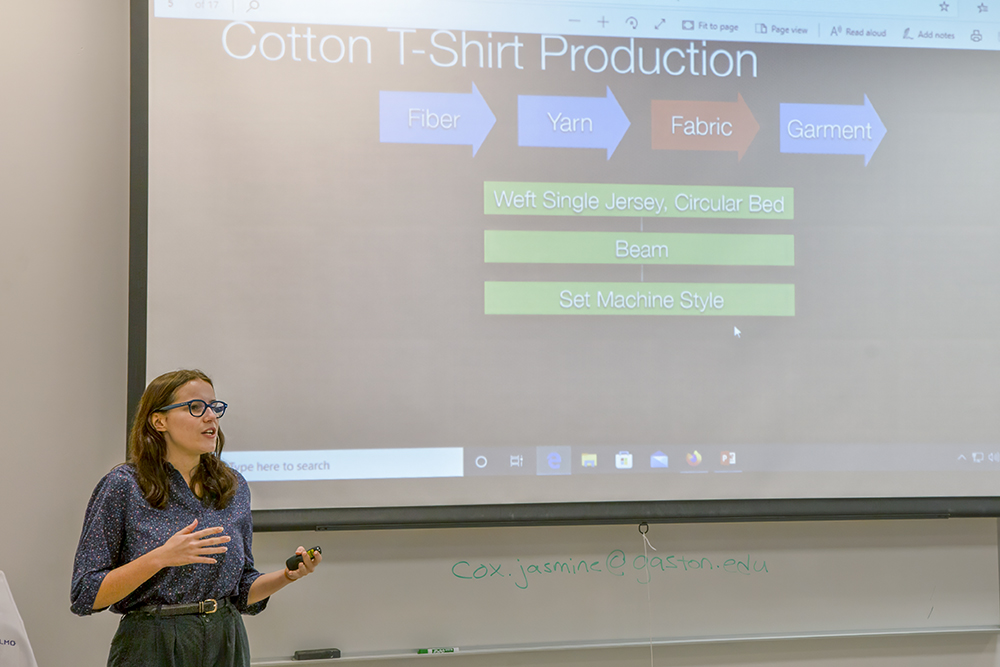
Lauren Eck presents her winning projectThe winning project was “Cotton Production and Manufacturing Inefficiencies” by student Lauren Eck. “Her project represented a deep level of understanding of project parameters, and her proposal addressed challenges and solutions at all levels of the value chain, i.e., farm, textile processing and final product,” said Tameka R. Peoples, founder/CEO and director of operations at Seed2Shirt. “Most importantly, Lauren’s project proposal highlighted critical educational points regarding the challenges of waste in fast fashion at the consumer and textile/fabric design levels.”

According to Peoples, Lauren’s proposal and final project included some critical farm solution recommendations that Seed2Shirt sees tremendous value in pursuing, including U.S. Department of Agriculture grants that support farm regenerative practices.

All the students who participated in the project received a one-of-a-kind Seed2Shirt T-shirt which embodies sustainable and ethical production standards. As the winner of the project challenge, Lauren Eck also received an exclusive pre-release Seed2Shirt Member Box.

“Gaston College, with its Textile Technology program, is one of the leading educational and innovative technology campuses/centers in the state of North Carolina,” said Peoples. “The program and campus are well known for educating and producing high caliber textile services and leading industry professionals, which is critical for growing the diverse U.S. textile industry and critical in supporting companies like Seed2Shirt in growing a more resilient, sustainable future for U.S. textiles.

“Lauren’s project, along with all the students who participated in our inaugural sponsored Sustainable Textile project, was the epitome of the professional excellence the Gaston College Textile Technology program produces,” Peoples continued. “Thank you to Lauren and everyone who participated, and to Gaston College for their collaborative partnership—you are the example of what it will take to grow U.S. textiles’ sustainable future.”

Seed2Shirt is the first company to sponsor a student project for the Textile Technology program, and they intend to continue their collaborative sponsored partnership work with the program and to support annual semester projects to provide more exposure and opportunity pathways for Gaston College students. Jasmine Cox-Wade, program chair and executive director of the Textile Technology Center, said, “In the future we would like to work with several organizations to support student learning. Partnering with the Gaston College Textile Technology program will provide companies with the opportunity to engage with students prior to graduation and provide exposure and awareness of what a modern-day textile industry job consists of.” Companies interested in sponsoring a semester project or serving as a guest speaker can contact Cox-Wade at [email protected].


Gaston College participates in round table with White House Representative

Gaston College and other members of the N.C. Textile Innovation and Sustainability Engine participate in round table with the director of the White House Office of Science and Technology

NCTISE is an inaugural winner of the NSF Regional Innovation Engines award

On Wednesday, February 21, Jasmine Cox-Wade, executive director of the Gaston College Textile Technology Center, participated in a round table discussion with fellow textile industry leaders during an event that took place at the Manufacturing Solutions Center in Conover, N.C.

The event followed the January 29, 2024, announcement from the U.S. National Science Foundation that the North Carolina Textile Innovation and Sustainability Engine is one of ten groups to win the inaugural NSF Regional Innovation Engines award. Gaston College is a member of the NCTISE leadership team. The other members of the leadership team are The Industrial Commons, NC State University Wilson College of Textiles, the Manufacturing Solutions Center at Catawba Valley Community College, NC IDEA, the N.C. Department of Commerce, RTI International, and Western Piedmont Community College.

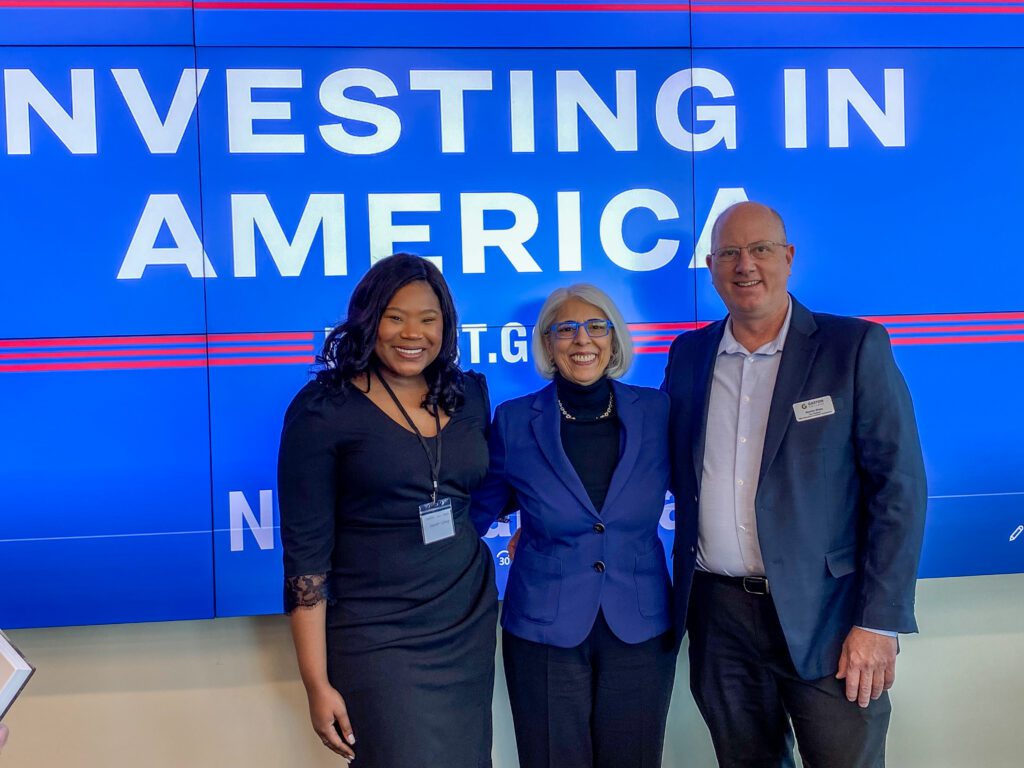
The MSC welcomed Michal Ziv-El, NSF program director, Graciela Narcho, NSF deputy assistant director, and Arati Prabhakar, director of the White House Office of Science and Technology, who toured the facility prior to the round table discussion. Dr. Prabhakar was visiting North Carolina as part of President Biden’s Investing in America Tour.

During the round table discussion, Cox-Wade addressed the importance of technical training through community colleges and touted Gaston College’s Textile Technology associate degree program, which prepares students for work as textile technicians and as textile designers. The program offers an affordable, accessible education and the ability to transfer credits to a four-year university, such as NC State, along with work-based learning opportunities that put students on the path to a career in textiles.

The NSF Regional Innovation Engines award, “Creating a Modern, Green and Inclusive Textile Sector,” will advance our nation’s capacity for innovation in textiles through a lens of environmental sustainability and with an eye toward circularity, positioning the Engine as a global leader in this sector. The award grants the Engine $15 million over two years with the possibility of future additional funding.

Gaston College's Jasmine Cox and Stephen Sharp with Director of White House Office of Science and Technology


Donation of equipment from Uster Technologies

Uster Technologies, a global leader in quality testing instruments headquartered in Zurich, Switzerland, has donated fiber and yarn testing equipment valued at over $1.2 million to the Gaston College Textile Technology Center. The company has partnered with the Textile Technology Center for over 10 years to offer textile industry customized training seminars and training for students in the Textile Technology associate degree program.

The donated equipment is used for yarn testing, evaluation of tensile properties, fiber process control, and yarn classification, and it has enabled Textile Technology Center laboratory personnel to provide clients with data to support the latest advancements in sustainability and functional textile innovations.

The equipment will be showcased in the Kimbrell Classroom Building on Gaston College’s campus in Belmont, N.C., when building renovations are complete. “We hope that with the pending upfit and renovation of our laboratory facility, we can expand our training catalog with the help of the equipment donated by Uster,” said Jasmine Cox-Wade, Executive Director of the Textile Technology Center.

An additional piece of equipment, the Uster HVI 1000 M1000, used for fiber classification analysis, will be delivered upon completion of the state-of-the-art Fiber Innovation Center, which is currently under construction on the Gaston College Kimbrell Campus. The FIC is scheduled to be completed by early 2024.